
Crypto vs. Stocks: A Beginner’s Guide to the Digital vs. Traditional investment World
So, you’ve heard the buzz. Your friends are talking about Bitcoin, Dogecoin, and the latest meme stock. The financial news is a whirlwind of discussion about the S&P 500, the Dow Jones, and market dips and rallies. You’re ready to get in on the action, but you have no idea where to start. It feels like you’re standing at a crossroads between two completely different universes: the traditional world of stocks and the new, wild frontier of cryptocurrencies.
This article is for you. We’re going to break down the key differences and similarities between investing in crypto and stocks, all in plain, casual English. We’ll explore what each one is, how they work, the risks and rewards involved, and ultimately, what you need to consider before you take the plunge. By the time you’re done reading, you’ll have a much better understanding of these two investment avenues and be better equipped to decide which path, or combination of paths, is right for your financial journey.
What’s a Stock, Anyway? The Basics of Traditional Investing
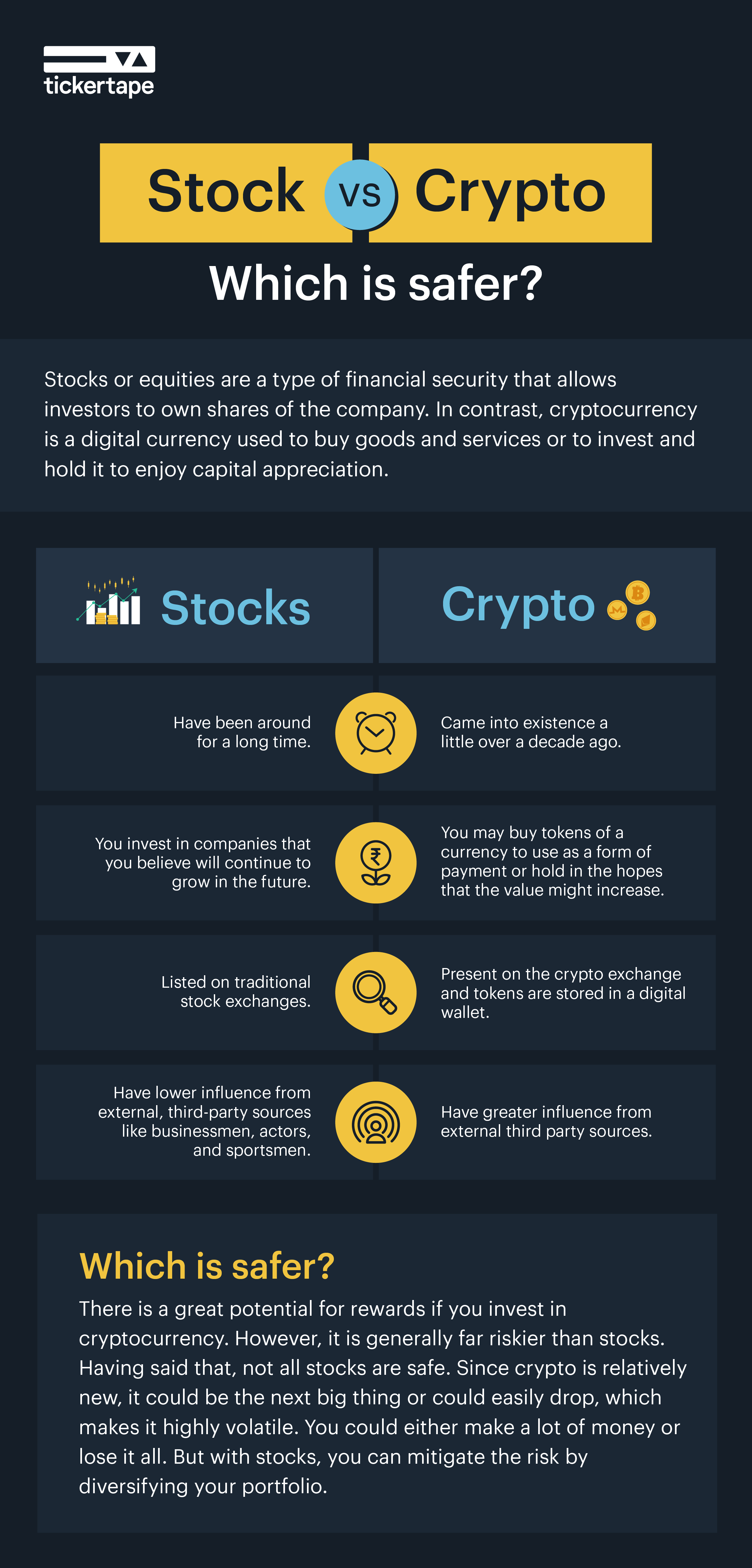
Let’s start with something familiar to many: stocks. A stock, or a share of stock, is simply a piece of ownership in a company. When you buy a share of stock in, say, Apple or Microsoft, you’re becoming a part-owner of that company. You’re betting on the company’s future success. If the company does well, its value goes up, and the value of your shares increases. This is called capital appreciation.
Stocks have been around for centuries, and the system is well-established and heavily regulated. There are rules and laws to protect investors, and the companies you invest in have to follow strict accounting and reporting standards. This is one of the biggest reasons people feel comfortable investing in the stock market—there’s a long history of solid returns and a lot of oversight.
The value of a stock is tied to the company’s performance, its assets, its revenue, and its future potential. Investors can analyze a company’s financial health, look at its leadership, and study its market position to try and predict if the stock will go up or down. This is called fundamental analysis. When a company is profitable and growing, it often pays out a portion of its earnings to shareholders as dividends, which is another way investors can make money from stocks.
You typically buy and sell stocks through a brokerage account, which acts as the intermediary between you and the stock market. These markets, like the New York Stock Exchange (NYSE) or the Nasdaq, have set trading hours, usually Monday through Friday.
So, in a nutshell, stocks are a way to own a piece of a business, with their value tied to the company’s real-world performance. It’s an investment with a well-trodden path and plenty of data to help you make decisions.
The Wild West of Crypto: What’s the Deal with Digital Assets?
Now, let’s talk about the new kid on the block: cryptocurrency. Unlike a stock, a cryptocurrency isn’t a piece of a company. It’s a digital asset, or a type of digital money. The first and most famous is Bitcoin, but there are thousands of others, often called “altcoins,” like Ethereum, Solana, and countless others.
The key difference with crypto is its underlying technology: blockchain. Think of a blockchain as a public, digital ledger that records every transaction. It’s decentralized, meaning it’s not controlled by any single entity, like a bank or a government. This is a core principle of crypto and one of its main selling points for many people. It removes the need for a middleman, allowing for peer-to-peer transactions.
The value of most cryptocurrencies isn’t tied to a company’s assets or cash flow. Instead, their price is driven by supply and demand, speculation, and market sentiment. People buy and sell crypto because they believe its value will go up in the future. They are betting on the technology, the community behind it, and its potential to become a widely used form of currency or a building block for new applications (like with Ethereum’s smart contracts).
Because of this, the crypto market is famously volatile. Prices can swing wildly, with huge gains and massive losses happening in a very short amount of time. It’s a 24/7 market, so you can buy and sell at any time of day or night, which adds to the frenetic pace.
To invest in crypto, you’ll use a cryptocurrency exchange, like Coinbase or Binance, to buy and sell digital coins. You’ll also need a digital wallet to store your crypto, which can be a little more complex than a traditional brokerage account. The regulatory environment for crypto is still evolving, which can create uncertainty but also offers a different kind of freedom for investors.
So, crypto is a decentralized digital asset whose value is largely driven by speculation and its potential to disrupt traditional financial systems. It’s a high-risk, high-reward game that’s not for the faint of heart.
Head-to-Head: The Major Differences
Let’s put stocks and crypto side-by-side to really highlight the key distinctions.
# 1. Ownership and Intrinsic Value
# 2. Regulation and Security
# 3. Volatility and Risk
# 4. Market Hours
# 5. Purpose and Use Case
Which One Should a Beginner Choose?
This is the million-dollar question, and the answer isn’t a simple “stocks” or “crypto.” It’s a personal decision based on your financial goals, risk tolerance, and investment horizon.
For most beginners, starting with stocks is a safer and more traditional approach. Here’s why:
However, that doesn’t mean you should ignore crypto entirely. If you have a high-risk tolerance and an interest in new technology, you could consider a small allocation of your portfolio to crypto. Think of it as a speculative play—an opportunity for potentially outsized returns, but with the understanding that you could lose that investment.
A common strategy for more adventurous beginners is to build a solid foundation with traditional stocks and then allocate a small percentage (think 1-5%) of their investable funds to cryptocurrency. This allows you to participate in the potential upside of the crypto market without putting your entire financial future at risk.
Getting Started: A Step-by-Step Guide for the Curious Beginner
If you’re ready to start, here’s a simple, actionable guide.
# Step 1: Open a Brokerage Account (for Stocks)
You’ll need a brokerage account to buy and sell stocks. There are many options out there, like Fidelity, Vanguard, or Charles Schwab, that are well-known and trusted. The process is similar to opening a bank account. Once your account is funded, you can start buying stocks or, even better for a beginner, low-cost index funds or ETFs (Exchange-Traded Funds) that give you exposure to a wide range of companies.
# Step 2: Open a Crypto Exchange Account (if you’re feeling brave)
If you want to dabble in crypto, you’ll need to open an account with a cryptocurrency exchange. Look for well-established exchanges with a good reputation for security and customer service. You’ll need to go through an identity verification process (KYC – Know Your Customer) and link your bank account to fund your new account.
# Step 3: Do Your Research
This is the most important step for both.
# Step 4: Start Small and Diversify
Don’t put all your eggs in one basket. This is a cardinal rule of investing.
# Step 5: Be Ready for the Long Haul
Investing is a marathon, not a sprint. Short-term market fluctuations can be stressful. The best strategy for most people is to invest consistently over a long period of time and ignore the daily noise. This is especially true for crypto, where day-to-day volatility is the norm.
A Final Word on Mindset
Ultimately, the choice between stocks and crypto is a choice between two different philosophies of investing. Stocks are about participating in the established, regulated economy. It’s a time-tested way to build wealth, backed by centuries of history and real-world assets. Crypto, on the other hand, is about participating in an emerging, decentralized, and speculative economy. It’s a bet on the future of technology and a rejection of the traditional financial system.
There is no one-size-fits-all answer. For a beginner, the most prudent path is often to start with the stable foundation of stocks and, if their risk tolerance and interest align, to carefully and conservatively explore the world of crypto. The most important thing is to educate yourself, understand the risks, and never invest more than you are willing to lose. Your financial journey is unique to you, and the best decision is an informed one.


